University of Toronto Bissell Building Toronto, Canada
Iconic yet disorienting, celebrated yet avoided — the Bissell Building’s contradictions are also its brief.
The Bissell Building forms the northern anchor of Toronto’s Robarts Library complex, one of Canada’s great works of Brutalist architecture. Completed in 1971, its interlocking hexagonal forms and triangular geometries have shaped the St. George Campus skyline for over fifty years. Home to the Faculty of Information, a world-leading centre for research across data science, digital culture, archives, and user experience, the building carries real institutional weight. Yet for all its architectural presence, it often feels fortress-like and cellular, a place that resists rather than invites.
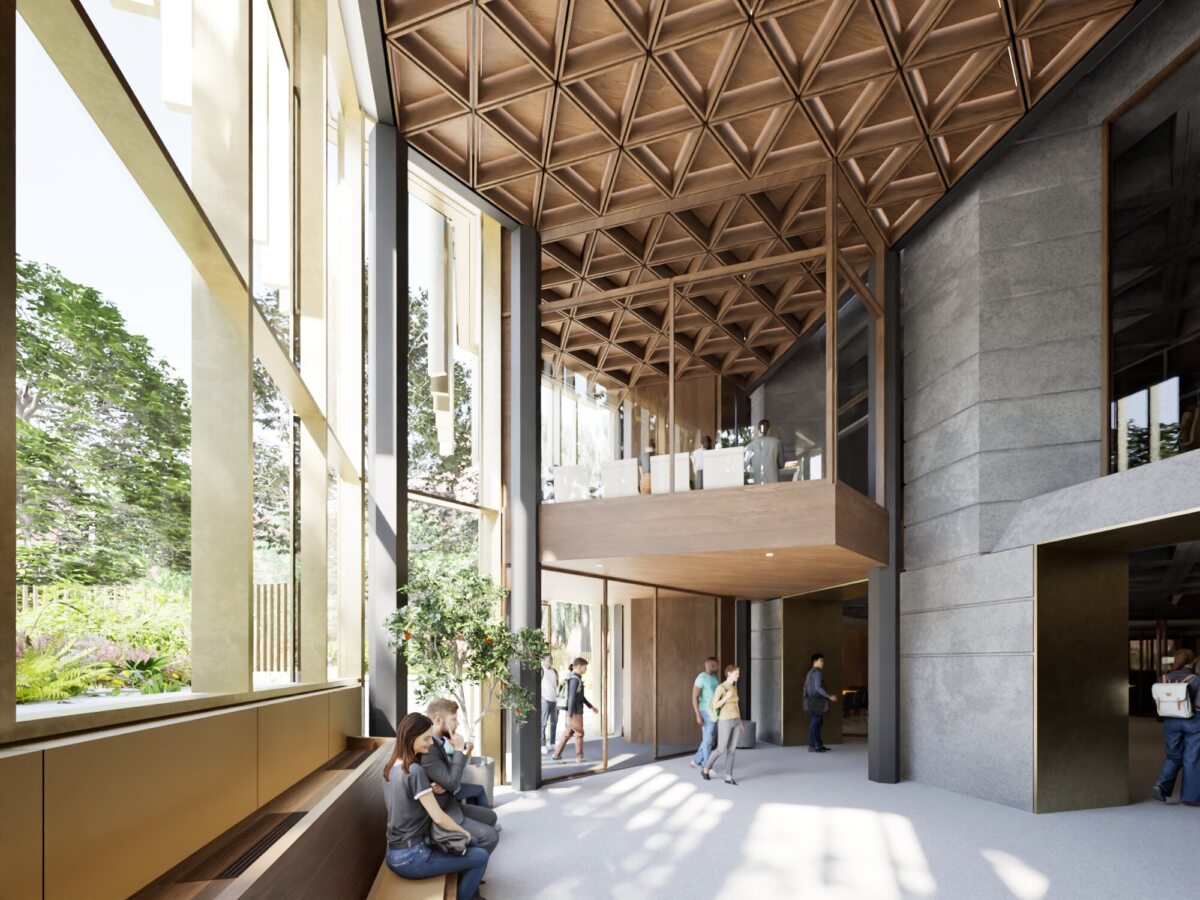
Our approach is to work with the building, not against it. Alison Brooks describes the goal simply: to reveal its potential. The existing geometry is not a constraint but the design’s raw material. By selectively opening the interior, the project transforms the building’s core into an airy social heart where students, researchers, and the wider community can genuinely converge.
A new pavilion-style entrance on Sussex Avenue will give the Faculty a front door worthy of its ambitions, stitching the building into campus life. Around it, expanded teaching rooms, research and design labs, maker spaces, and outdoor terraces support the Faculty’s model of experiential, experimental, and empirical learning. Heritage, accessibility, and Indigenous cultural recognition are woven throughout.
The Bissell design advances a considered position: that Brutalist buildings need not be demolished, preserved uncritically, or defended apologetically. With careful intervention, they can be made genuinely open and welcoming while retaining their architectural integrity.
-

-

-
-

-
 Aerial view of St. George campus looking South.
-

-
