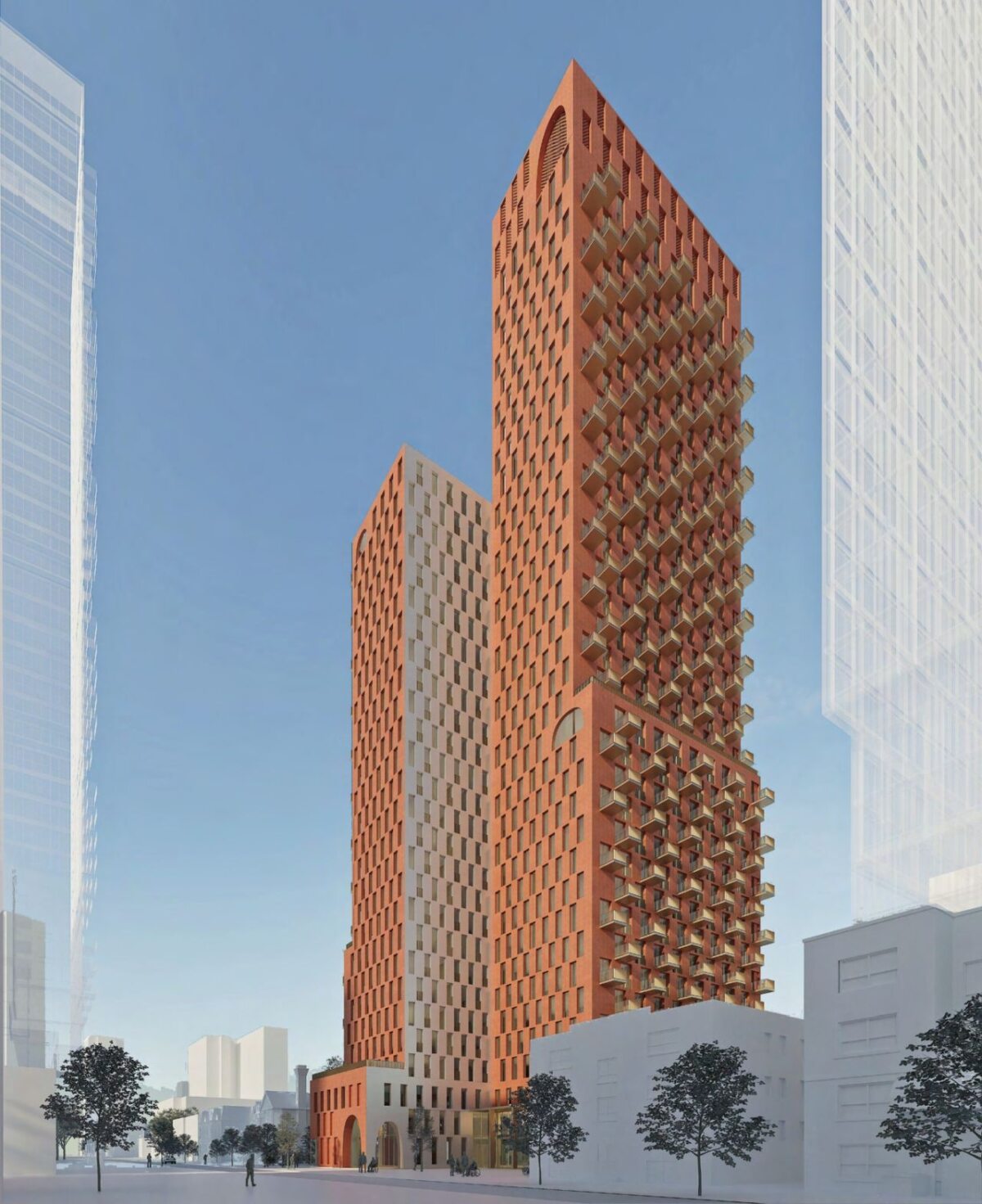
405 Sherbourne Toronto, Canada
405 Sherbourne showcases a design partnership between architects—Alliance and Alison Brooks Architects, uniting decades of shared expertise in multi-unit housing in vibrant urban centres. Developed for Toronto Community Housing and CreateTO, the project proposes a generous model of social housing: sustainable, efficient, family-oriented, and rooted in the lived experience of residents. Drawing on ABA’s considered, elevated approach to social housing, redefining housing as civic architecture underpinning urban regeneration in London, as well as a—A’s extensive experience in Toronto housing and city-building, 405 Sherbourne reflects a shared design ethos. The project advances the conviction that affordable housing can embody architectural, social, and ecological ambition.
Two towers of 35 and 26 storeys step down to meet the ground with generous threshold spaces: one addressing Bleecker Street and the other fronting Sherbourne Street. The two-tower arrangement carves out two gardens, creating simultaneously a front garden for residents and a new civic space for the public, while enhancing a landscaped mid-block pedestrian passage. A continuous double-height central foyer connects the building’s two entrances, landscaped forecourts, and streetscapes, forming a new neighbourhood link. 405 Sherbourne’s staggered silhouette is a characterful exploration of scale, mediating between the civic scale of Sherbourne Street, the emerging skyline, and the distinctly Victorian fabric of historic Cabbagetown.
The façade takes its cue from Cabbagetown’s material culture, not through imitation but through a shared commitment to mass, depth, and permanence. It is designed to support Toronto’s full range of seasons and to harmonise with the district’s architectural character through a contemporary expression of brick, stone, and bay windows.
Floorplates are planned from the inside out, supporting generous two- and three-bedroom homes. With the depth to accommodate dual-aspect layouts, units breathe across the building’s full width and draw daylight from two directions, taking inspiration from the generosity of the traditional family home.
405 Sherbourne is designed to meet the Toronto Green Standard with Thermal performance and reduced operational carbon embedded in its compact form, orientation and envelope strategy.
At ground level, the public realm is prioritised: a hardscaped block is transformed into a parkette framed by a planted passage. Urban greening and biodiversity extend across every scale, reducing the former parking area by 78 per cent while increasing biodiverse ground cover and extending the neighbourhood’s network of safe green spaces. A total of 331 bicycle spaces signals a new kind of urban life. Input from community stakeholders, TCHC, and CreateTO staff is shaping shared spaces that reflect residents’ needs, support informal gathering, foster daily connection, and add long-term value.