Banff Visitor Centre Banff, Canada
Entitled ‘Mountain, Forest, Feather’, our shortlisted proposal for Banff National Park Visitor Centre draws on the sublime landscapes of the Canadian Rocky Mountains to create a civic landmark rooted in both indigenous heritage and contemporary life.

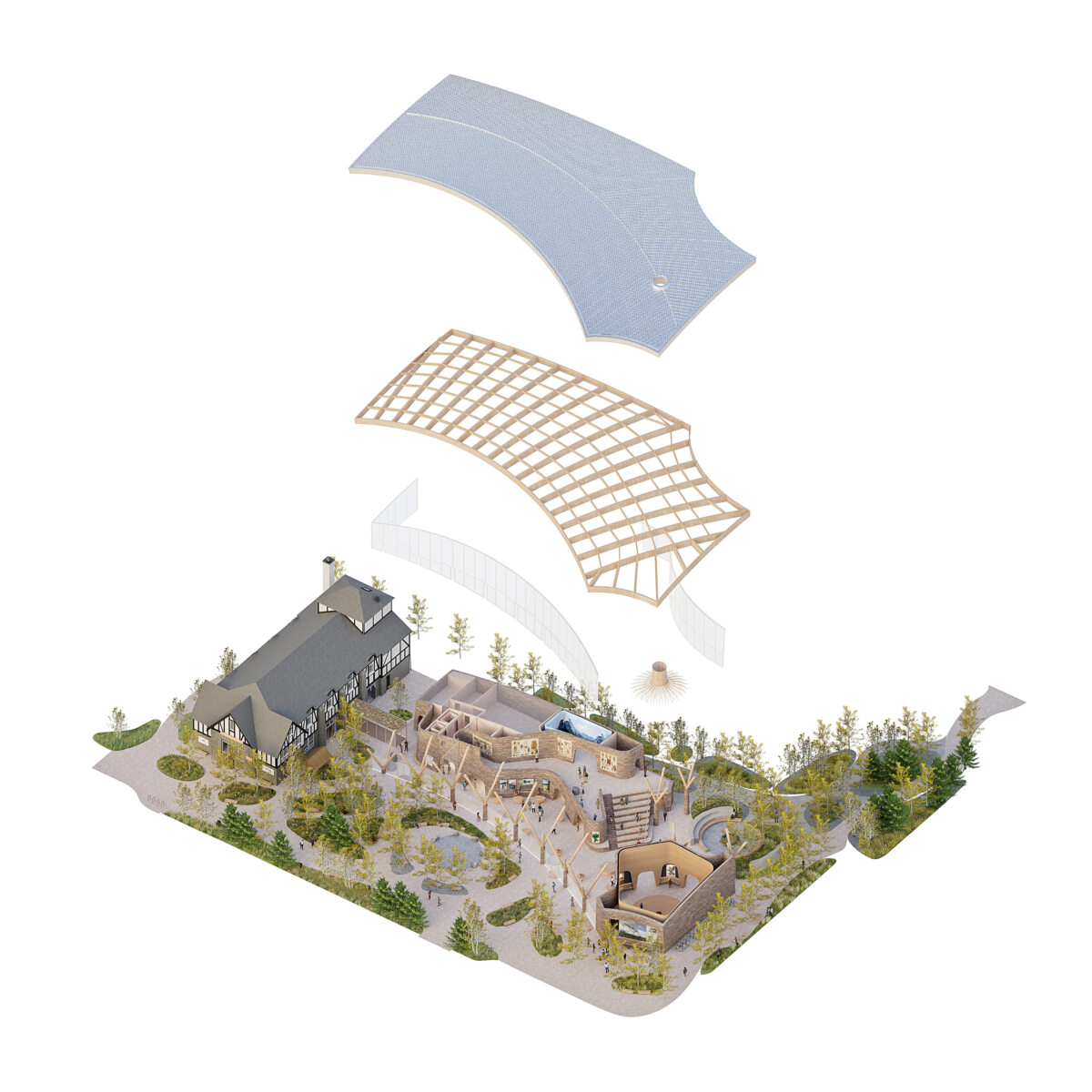
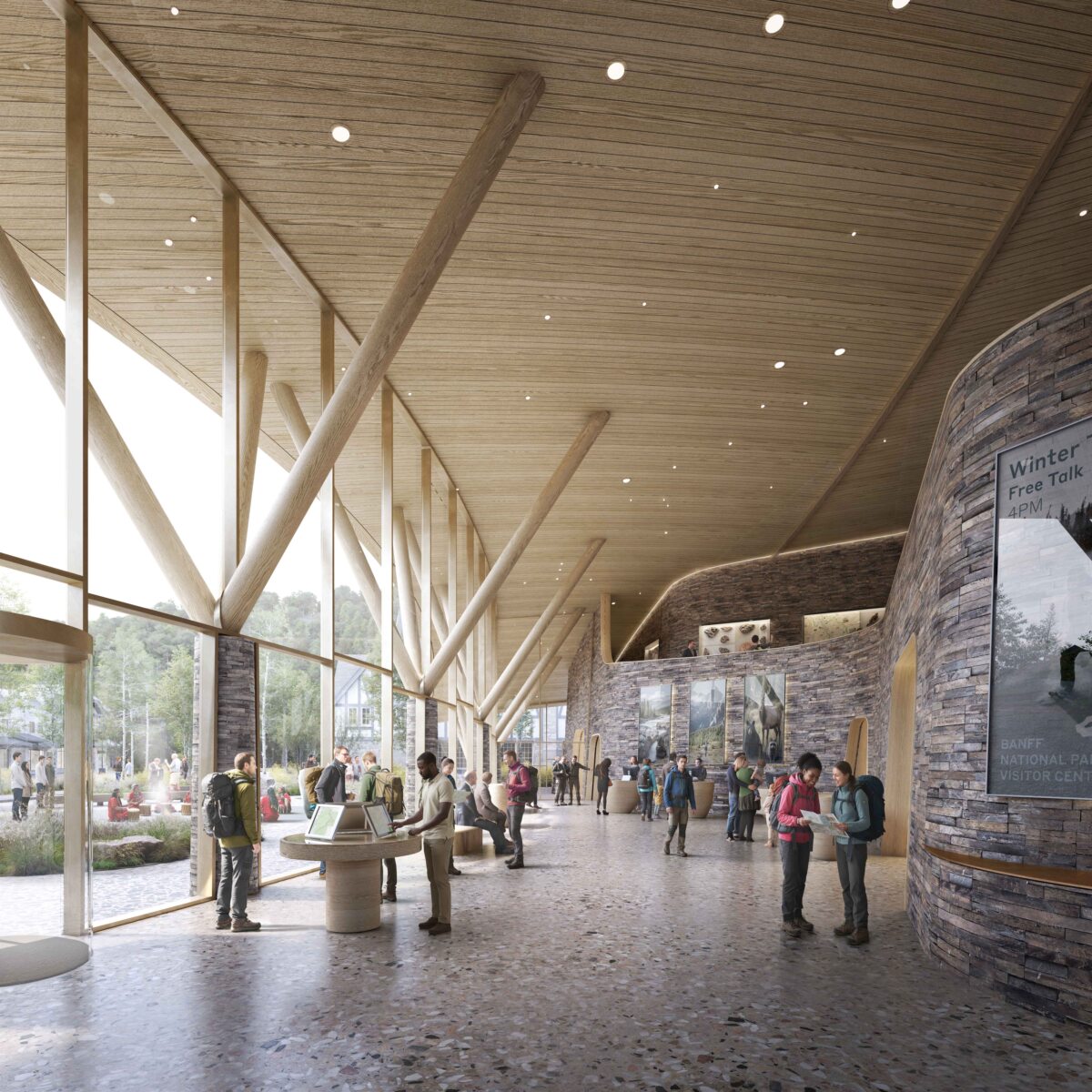

The design is organised around three elemental ideas. A central axis, precisely aligned with two mountain peaks, orients visitors the moment they arrive. Tree-like branching timber columns create a forest threshold, blurring the boundary between inside and out. Finally, a long and sweeping curved roof inspired by the eagle’s feather forms a new horizon line at the foot of Mount Rundle.
Central to the proposal is a commitment to the indigenous peoples of the land: the Piikani, Siksika, Stoney, Tsuut’ina and Métis Nations. Dedicated indigenous programming spaces are woven into the heart of the Visitor Centre, and circular outdoor geometries recalling clearings in a forest provide gathering and ceremonial spaces that honour the cultural significance of the site. The building is designed to serve not just tourists, but communities for whom this landscape carries deep and enduring meaning.
Inside, spaces unfold across a sequence of soft curves and shifting levels, accommodating everything from quick self-service orientation to extended exhibition visits, events and ceremony. A Riverbed Landscape Trail extends the experience eastward, connecting Banff Avenue to the heritage context of Beaver Street through a car-free laneway landscape.
The material palette is drawn directly from place: Rundle stone at the base, warm mass timber columns, terrazzo floors embedded with river pebbles, and a constellation-patterned soffit reflecting Banff’s dark skies. Fully electric, carbon-storing mass timber construction makes the building a model of environmental stewardship for a National Park.
The scheme also integrates 29 new residential apartments across four housing blocks, each with low-profile barrel-vaulted roofs that echo the arc of the Visitor Centre, and a carefully rehabilitated Parks Canada Heritage Building brought back to life through a new central atrium.
Together, the masterplan creates a landscape of meaning: a place for orientation, gathering, learning and ceremony, where architecture and nature exist in continuous conversation.